
Power Station Buying Guide – Find the right power station for your needs
Need power for your motorhome or summer cottage? Or are you concerned about potential power outages at home?A portable power stationcould be exactly what you need!
What is a portable power station?
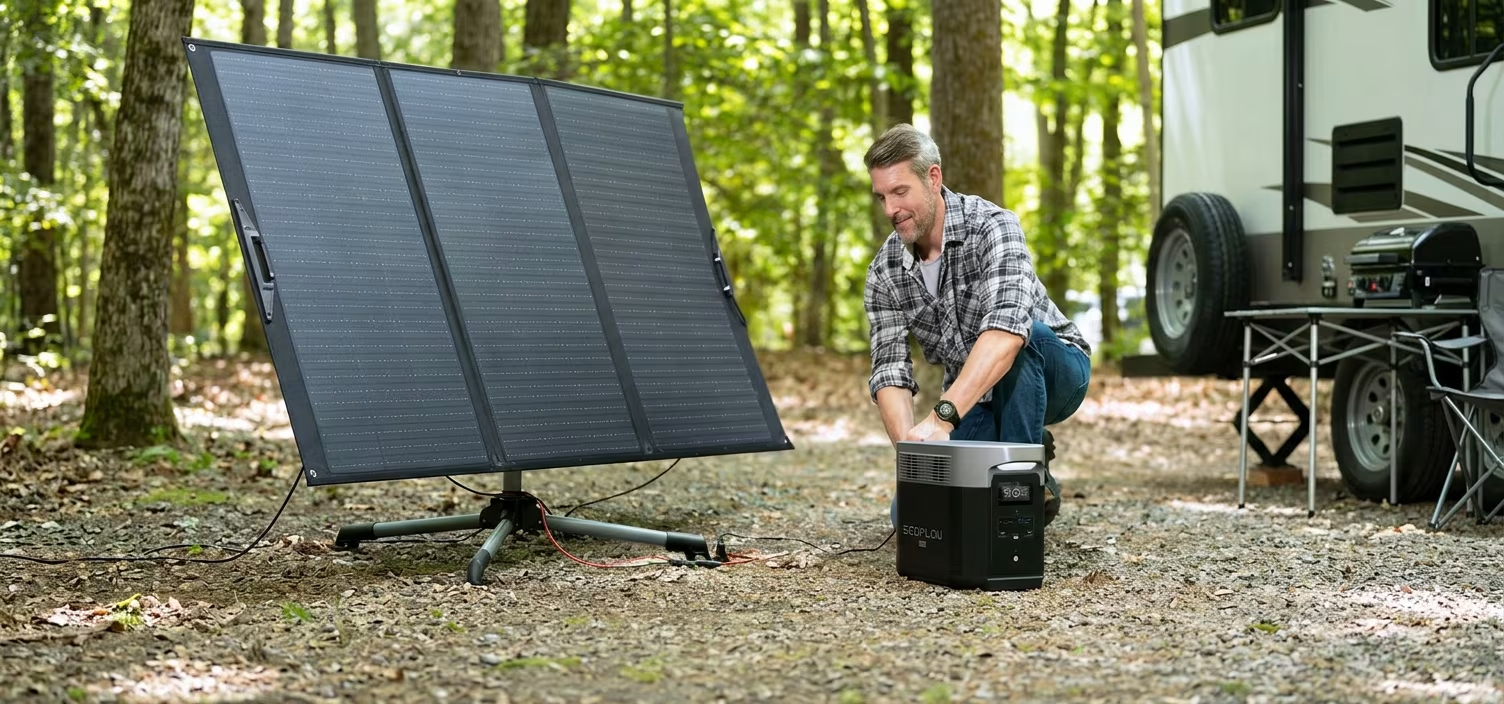
A portable power station functions much like a power bank: you charge the internal battery and use it to power various devices. The key differences are the AC outlet (Schuko socket) and the significantly higher battery capacity. While this makes them larger and heavier than pocket-sized power banks, they remain portable—the smallest models weigh just a few kilograms and fit easily in a backpack. Most power stations are also well-suited for RV trips and camping.

Portable power stations are ideal for the following situations:
- Camping, boating, or traveling by RV or caravan
- Off-grid cabins and cottages
- Backup power during home power outages
- Mobile workstations and remote work
What devices can a power station power?
Power stations are ideal for a wide range of uses. The right choice depends on your specific needs, as well as the station's battery capacity, power output, and port selection.
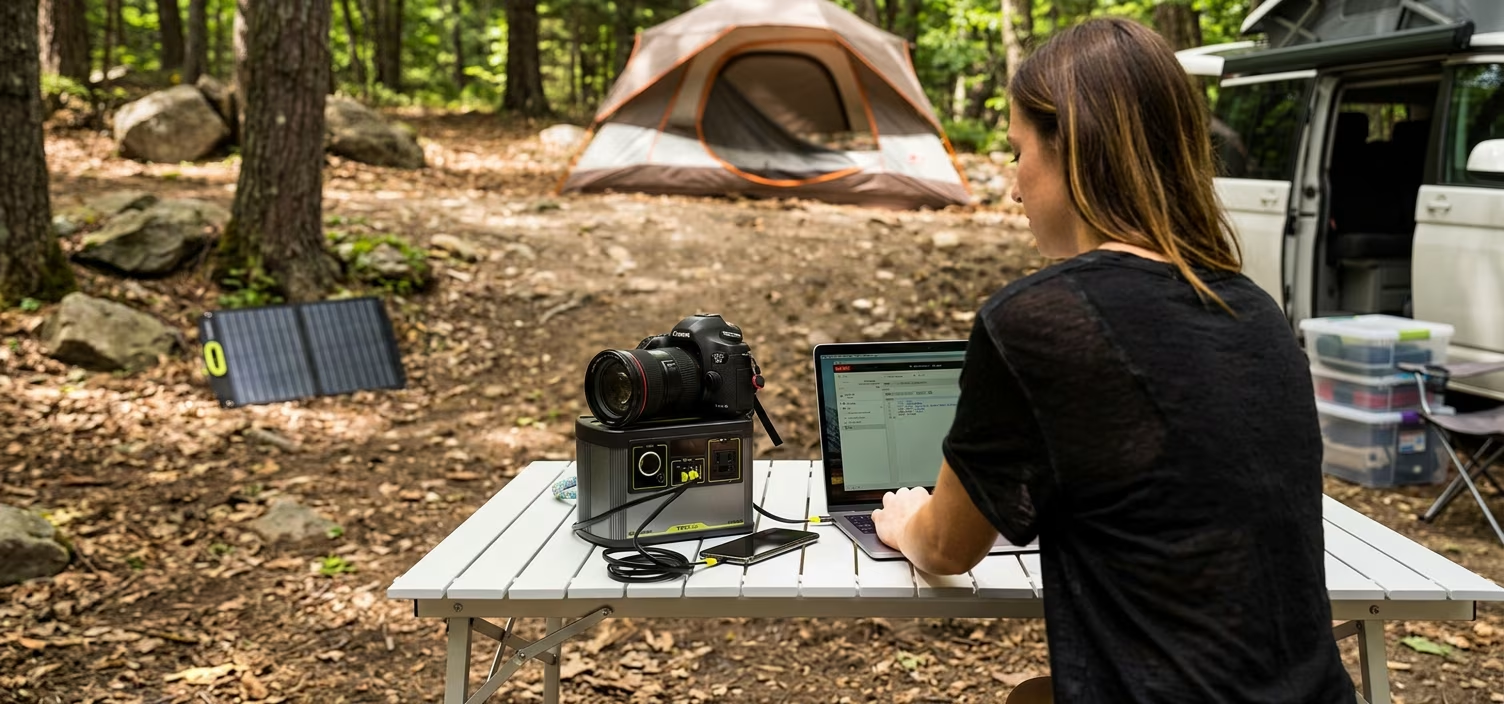
Smaller power stations are typically used with devices such as:
- Phonesandtablets
- Laptops
- Lights,headlamps,cameras and drones
- Smallerportable fridges and coolers
- Other small household appliances
Larger and more powerful power stations are often used for:
- Cooking appliances
- Cooling appliances, such asrefrigerators
- Entertainment electronics, such astelevisions
- Climate control, such asfans
- Other large household appliances
- Power tools
Power Station Differences – How to Choose the Right One for You?
When buying a power station, consider these questions:
- What will you use the power station for?
- How much power and battery capacity do you need?
- Which ports and connections do you need?
- Will you move the power station frequently?
Power stations can vary significantly in size, weight, battery capacity, power output, and available ports. Generally, more powerful power stations are also larger and heavier. Keep this in mind if you plan to move the power station frequently from place to place.
Power station battery capacity (Wh)
Battery capacity indicates the amount of electrical energy stored in a power station. Some models allow you to expand capacity later with an expansion battery. When purchasing, consider how much capacity you need and whether you might want to add more batteries in the future.
This table showsestimatedruntimes for electrical devices across different battery capacities. The table does not account for inverter efficiency or power loss during DC-to-AC conversion. You can calculate an estimated runtime as follows: battery capacity (Wh) / power (W) = runtime (h).
| Power station, 200 Wh | Power station, 1000 Wh | Power station, 3600 Wh | |
| Fridge 120 W | ~1 h 40 min | ~8 h | ~30 h |
| Car fridge 60 W | ~3 h 20 min | ~16 h 30 min | ~60 h |
| Coffee maker 1000 W | – | ~1 h | ~3 h 30 min |
| TV 110 W | ~1 h 45 min | ~9 h | ~32 h 30 min |
Power Station Output (W)
The power station output indicates the maximum combined power draw of connected devices. For example, a 600 W power station can handle a 600 W load. If a connected device requires more power than this, it won't work with that power station.
Power Station Ports:
Power stations vary in their port configurations, so it's worth paying attention to these differences. Most power stations include a 230 V AC outlet and at least one USB port. There may be multiple ports, and higher-capacity models typically offer more. When buying a power station, keep in mind that port power ratings can vary. The total power station output doesn't necessarily reflect the power available at each individual port.
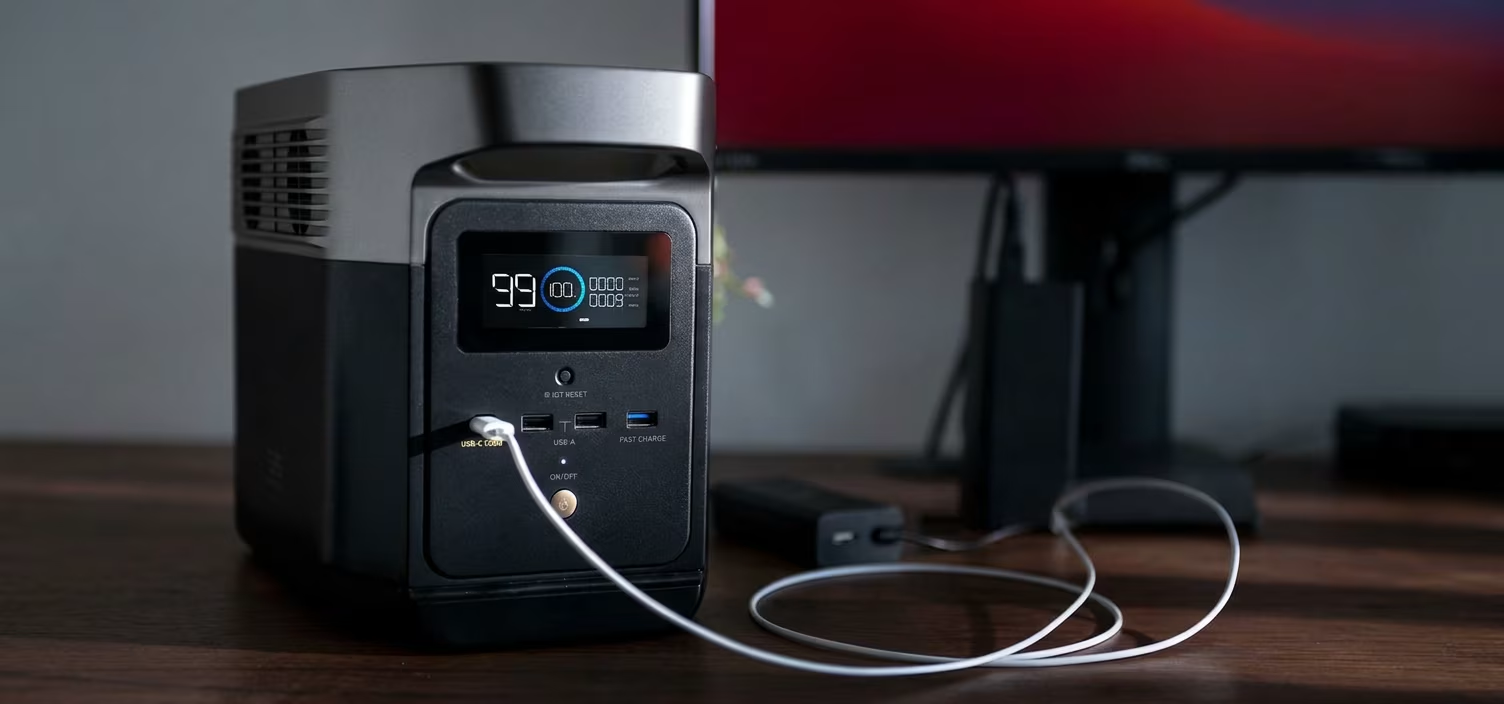
Charging a Power Station – How and What to Use
Many power stations can be charged from a wall outlet, solar panel, or car cigarette lighter. If you're charging your power station in a car via the cigarette lighter, we recommend only charging while the engine is running to avoid draining your car battery.
Charging from a wall outlet or car cigarette lighter
For the fastest charging, use a wall outlet (AC power). Some power stations also feature bidirectional USB-C ports, allowing you to charge the battery through USB-C in addition to the AC input.
Check your power station's charging wattage if you're charging via a wall outlet or cigarette lighter. Larger power stations may have high charging power, which can blow a fuse. In addition to the power station's charging wattage, check how much power the outlet or cigarette lighter fuse can handle and whether other devices are connected simultaneously. Some power stations have a feature that lets you adjust charging power through a mobile app, for example. Using this feature can help prevent blown fuses.
Charging with a solar panel
The solar panel's wattage affects how quickly the power station charges. In some cases, you can connect multiple solar panels to a power station for increased charging power. When using solar panels, you need to consider the power station's solar charging requirements. The solar panel's technical specifications must be compatible with the power station's requirements. Also note that a solar panel's high nominal wattage won't help if the power station can't utilize it.

Charging with a generator
You can also charge a power station with a generator. Generators are devices that produce electricity using a fuel-powered combustion engine. They're useful when other charging methods aren't available, such as solar panel charging in cloudy weather. When using a generator, make sure it produces pure sine wave power. Never charge a power station battery with a generator that outputs modified sine wave power.
What else should you consider when buying a power station?
When buying a power station, keep in mind that the battery will degrade over time just like any other battery. You should also consider the type of sine wave the power station produces to avoid damaging your devices.
Power station battery degradation
Like other batteries, power station batteries gradually lose performance over time. There can be significant differences between power stations in how well the battery holds up over the long term. The battery chemistry used has the biggest impact on this. For example, power stations with LFP battery chemistry can last for several thousand charge and discharge cycles, after which around 80% of the original battery capacity may still remain. Before purchasing, check the product specifications to see how many charge cycles the battery is rated for.
Pure sine wave or modified sine wave power station?
A power station produces either modified or pure sine wave output from its 230 V AC outlet. Budget power stations typically produce modified sine wave, while more expensive models produce pure sine wave, which is the same type of electricity that comes from your home outlet. If you're using more sensitive electronics and need 230 V power, it's worth investing in a pure sine wave power station. Some 230 V devices can actually be damaged by modified sine wave output.
Verkkokauppa.com's tip
When connecting a device that supports both 12V DC and 230V AC, we recommend using the 12V DC output. Using the 230V outlet requires the internal inverter to convert DC power from the battery into AC power, which consumes additional energy. The power station is more efficient when using the DC outputs directly.
Give us feedback – was this article helpful?
We’d love to hear from you! Rate this article on a scale of 1–5 and let us know how we could make it even better.
Give feedback (Ulkoinen palvelu) (Avautuu uuteen välilehteen)